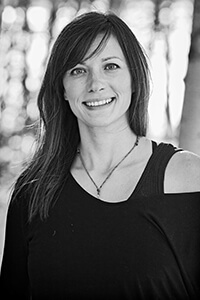
 Peggy
Peggy
Clinic: Banff
M.OMSc (Masters in Osteopathic Manual Sciences)
Born in Germany, Peggy moved to Banff in 2008 and quickly fell in love with the mountains and the strong sense of community. She believes that an active and balanced lifestyle is foundational to both mental and physical well-being.
Peggy began her healthcare career as a Registered Massage Therapist after completing the 2200-hour program at MH Vicars School of Massage Therapy in Calgary. Her early practice was rooted in a holistic philosophy, focusing on identifying and addressing the underlying cause of pain and tension rather than simply treating symptoms.
Driven by a desire to deepen her understanding of the body’s mechanics and self-healing capacity, Peggy went on to complete four years of full time osteopathic training at the Canadian Academy of Osteopathy. Her studies emphasized the relationship between structure and function, classical osteopathic principles and a precise, hands-on approach to restoring alignment and optimal movement.
Now practicing as an Osteopathic Manual Practitioner, Peggy integrates her background in massage therapy with a comprehensive osteopathic assessment and treatment approach. She is passionate about helping her patients achieve lasting results by supporting the body’s natural ability to heal and self-regulate.
[row][/row]
How would you describe your style of Osteopathy?
My approach is rooted in classical osteopathy, a system of manual healthcare based on the principle that structure and function are inherently interconnected. When the body’s framework is balanced and aligned, it can move, circulate, adapt and heal more efficiently.
Classical osteopathy does not rely on a set sequence of techniques or protocol-driven treatments. Instead, it is guided by a detailed assessment of what the body presents with on that particular day. Every patient is evaluated individually, and treatment is tailored to their current structural patterns, compensations, and restrictions. Because of this, no two treatments are the same — even for the same person. The body is dynamic and constantly adapting to stress, activity, injury and life circumstances. Each session responds to those changes in real time which allows treatment to be both specific and holistic, supporting the body’s inherent capacity to self-regulate and heal.
What do you do when you aren’t working at the clinic?
Outside of the clinic, I feel most at home in nature. Living in the mountains has deeply shaped who I am and I spend as much time as I can outdoors, whether that’s trail running, hiking or simply soaking in the fresh air and quiet. Movement is an important part of my own well-being and I also enjoy practicing yoga as a way to stay balanced and grounded.
I cherish time spent with family and loved ones and I share my life with my son, my partner, our two dogs and a bunny, who keep things playful and full of energy. Being connected to community, nature and the outdoors continues to inspire both my personal life and my work as a practitioner.
What made you decide to become an Osteopathic Manual Practitioner?
My path toward osteopathy grew from a deep desire to truly understand how the body works and how closely its patterns mirror those found in nature, adaptive, interconnected and self-regulating. Experiencing chronic illness within my family led me to search for a healthcare approach that made sense of complex, long-standing conditions rather than simply managing symptoms. Osteopathy was the first system that offered a framework I could trust and understand. When my son was born with clubbed feet, that calling became even more personal, I wanted to be equipped with the knowledge and hands-on skill to support his body’s development and healing.